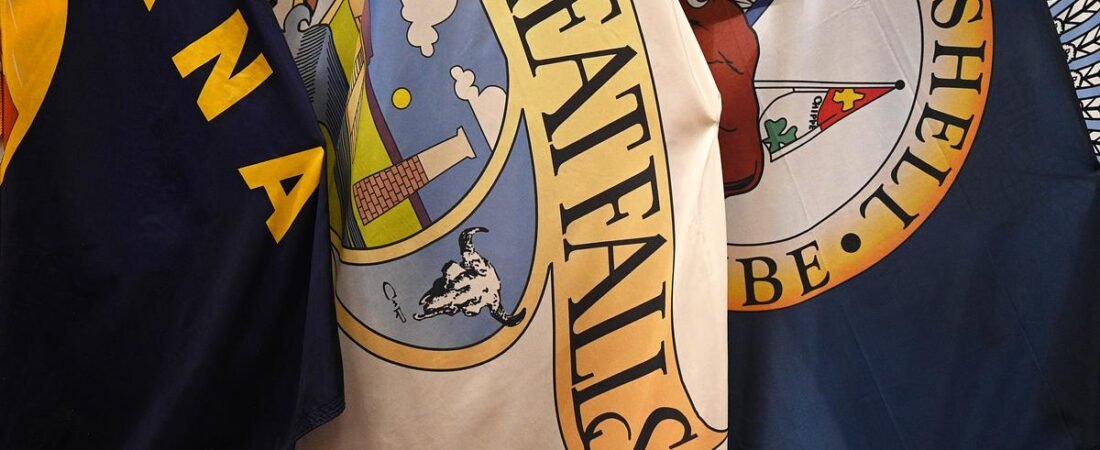
The Little Shell Tribe of Chippewa Indians of Montana has gained the city’s approval to build a large affordable housing development on land that was once home to the Indigenous poor in Great Falls.
Late Tuesday night, the Great Falls City Commission approved a plan and the annexation of 18.4 acres of tribally owned property into the city for the project. It calls for 115 housing units, including 65 single-family homes and duplexes and two apartment buildings with 50 units. It’s called the Good Medicine development.
The development is largely funded through a federal Indian housing program.
The project’s final approval with the city commission came after months of pushback from residents of the adjacent Valley View neighborhood, concerned about traffic and pedestrian safety. Tuesday’s meeting lasted nearly four and a half hours, with lines of commenters both for and against.
The development is the latest in a string of economic development projects for the tribe of “landless Indians” that gained federal recognition in 2019. The Little Shell’s holdings in recent years have grown to include a tribal health clinic and a ceremonial center that opened earlier this year.
This newspaper clipping from 1956 shows two girls who lived on Hill 57 in Great Falls. Indigenous residents lived in difficult conditions along Hill 57, but a new Little Shell development aims to add new affordable housing on that land. Credit: Matt Hudson / MTFP / Cascade County Historical Society
Little Shell Chairman Gerald Gray has positioned the Good Medicine project, the largest among the developments, as a partnership between governments. The land will be under the city’s jurisdiction and taxed like other typical residential developments.
“The decision to request annexation reflects our sovereignty,” Gray told commissioners at the meeting. “Sovereignty is not diminished when governments work together. Sovereignty is demonstrated by having the authority to make that choice in the best interest of our citizens.”
The homes will be built in the area colloquially known as Hill 57 on the west end of Great Falls. It was a place where Indigenous peoples with different tribal affiliations, including the Little Shell, gathered in ramshackle homes and lived in impoverished conditions well into the 20th century.
“I remember how shameful it was that people lived on Hill 57 like that,” City Commissioner Shannon Wilson said during Tuesday’s meeting.
Richard Parenteau spoke at Tuesday’s meeting and said his wife, Mary Gopher-Parenteau, grew up on Hill 57. He recalled stories about collecting wood to heat one-room shacks and walking a quarter-mile to get water. He and others view the forthcoming housing project as a reversal of that difficult period.
“I’d love to see housing close to Hill 57,” Parenteau said.
Today, the Little Shell tribe owns land around Hill 57, now referred to as Mount Royal. The housing development will be built next to an existing ceremonial center and food distribution building. Atop the hill, the tribe has long-term plans for a major resort and casino.
Representatives from local development organizations, such as NeighborWorks Great Falls and the Great Falls Development Alliance, spoke in favor of adding 115 homes to ease pressure on local housing demand. The GFDA, in particular, has cited its own studies indicating that the city is experiencing a housing shortage requiring 650 homes to be built each year.
“We do about double digits in his city annually,” said GFDA’s Jake Clark, indicating that construction has fallen short.
A Little Shell housing needs assessment showed that tribal households have an average of 3.1 people living in a household, and more than a third of homes reported multiple families living together, according to tribal housing director Sidney Curnow.
The Good Medicine affordable housing project aims to add 115 homes to the northwest corner of Great Falls. Credit: Courtesy of LSE Architects and TD&H Engineers
During Tuesday’s meeting, Little Shell tribal members also lined up to talk about the need for affordable homes and, more broadly, a permanent home for the tribe that refused a 19th-century treaty with the U.S. government and didn’t experience the complex reservation-centered history that other tribes had.
Shannon Houle Coffin, a tribal member, said that she planned to apply for a home in the new development. A teacher for more than two decades at Great Falls Public Schools, she said that her income has placed her in neighborhoods where she has felt unsafe. In public comments, she talked about her personal housing desires as part of a larger benefit for the tribe.
“We’re boarding-school survivors. We have a really painful history right here,” she said. “And since Little Shell has been federally recognized, I see a healing that is coming from the core. It is like a fire that is lit so white hot from the center, and we’re healing.”
Opposition to the project has fomented for months as the plans moved through neighborhood councils and the city’s planning board. While some comments over the months delved into stereotypes about tribal housing, most of the opposition focused on the safety implications of additional traffic.
The Valley View neighborhood, a quiet, hilly section of northwest Great Falls, has narrow streets and few sidewalks. Residents talked about how common it is for people, including schoolchildren, to walk down the street. They feared that additional traffic from 115 new homes would add congestion and put those pedestrians at risk.
“We heard for an hour and a half about how the Little Shell needs housing, and how good it would be for them,” longtime neighborhood resident Amy Door told commissioners Tuesday. “But it shouldn’t be at the expense of the people who have lived and been in Valley View for years and years.”
The city’s traffic analysis found that the planned and existing streets would be able to accommodate the added traffic and that few of the new residents would congest the Valley View neighborhood. Most drivers would likely head west out on Stuckey Road, city documents stated.
Opposing residents also feared that the tribe would pursue federal trust status for the land in the future. A transition to trust status, a mechanism available to tribal nations, could remove the property from local property tax rolls. The Little Shell tribe hasn’t indicated that it would pursue that for the housing development, but the city included a provision in the development agreement that the city could stop providing utility services and negotiate a new arrangement if the tribe pursues that option in the future.
Commissioners approved the housing project on a 4-1 vote, with Commissioner Joe McKenney opposed. While the project’s public rollout started in December at a neighborhood council, McKenney felt that some work still needed to be done to address the concerns of neighbors.
“I want to vote yes, but not tonight,” he said. “If we could delay this to the second commission meeting in August and give these folks more time to get to that win-win, we could be there.”
With the approval of the city commission, Little Shell representatives indicated that groundbreaking for the first phase of construction is ready to take place.
Skye McGinty, a tribal member health administrator for the Little Shell, placed the project in the context of braiding strands of sweetgrass. It’s typically a two-person job, she said, with one doing the braiding and the other holding the work together. The relationship is reciprocal.
“And I see our two governments, our city of Great Falls and our Little Shell government, on the ends of the sweetgrass,” McGinty said.
In-depth, independent reporting on the stories impacting your community from reporters who know your town.
LATEST STORIES
American scientists see prosecutions as part of federal campaign against them The Trump administration has stepped up arrests and public condemnation of federal scientists studying viruses as the world faces one of its worst Ebola epidemics.
Jury finds Ellsworth guilty of official misconduct A Helena jury found former state Senate President Jason Ellsworth guilty of misdemeanor criminal official misconduct for awarding $170,000 in no-bid contracts to a company represented by a long-time business associate. Jury deliberations took nearly four hours and left Ellsworth, a Hamilton Republican, potentially facing a six-month jail sentence. Ellsworth exited the courthouse shortly after the verdict was read. Lewis and Clark County District Court Judge Christopher Abbott set Ellsworth’s sentencing for Sept. 10.
Montana is selling more state trust land than it’s buying It’s been nearly a decade since the Land Board has purchased new trust land under the state’s 23-year-old ‘land banking’ program. Public-land advocates worry the state is leaving access opportunities on the table by selling land without pursuing replacement parcels to offset the acreage sold.