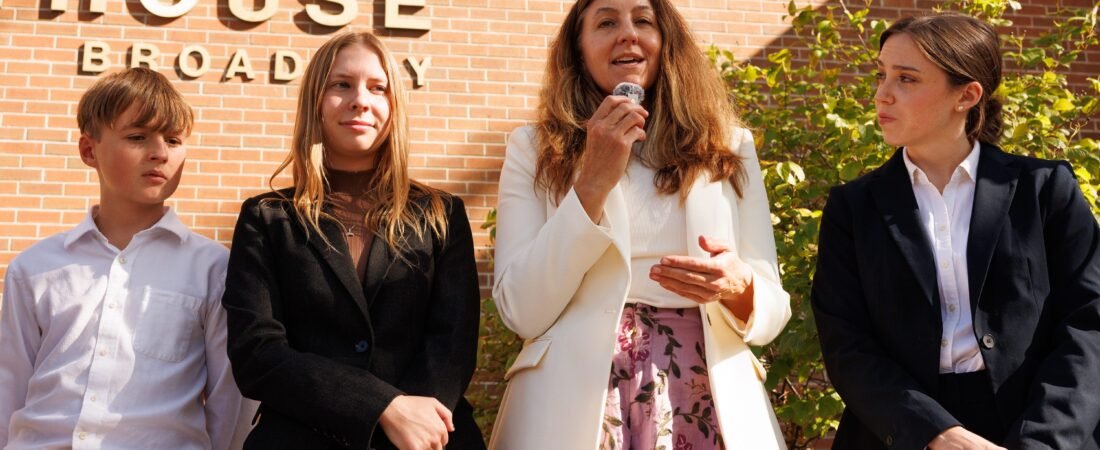
The young plaintiffs who challenged President Donald Trump’s 2025 executive orders to expand fossil-fuel production are asking an appellate court to revisit their appeal.
Our Children’s Trust, the Oregon-based nonprofit representing Eva Lighthiser and her 21 co-plaintiffs in the constitutional climate litigation, is asking for an “en banc” rehearing of its lawsuit. The plaintiffs are effectively asking a larger contingent of Ninth Circuit judges to evaluate whether the case should be reconsidered at the appellate-court level.
At issue are a trio of executive orders Trump issued in the early days of his second term seeking to expand fossil-fuel development and decrease permitting obstacles.
RELATED
Ninth Circuit Court denies young Americans’ lawsuit challenging Trump’s handling of climate change In a 10-page opinion, the Ninth Circuit wrote that the climate change-related injuries plaintiffs reported in their litigation bear too tenuous a tie to a trio of executive orders they sought to reverse with the lawsuit. The decision marks a major setback for the young Americans seeking to reverse President Trump’s pro-fossil fuel agenda and reinstate the climate adaptations pursued by his predecessor.
Lead plaintiff Lighthiser argued alongside her co-plaintiffs that the executive orders are expediting the harms young Americans are grappling with as the concentration of climate-warming carbon dioxide in the earth’s atmosphere increases. The plaintiffs, who hail from across the United States, point to wildfire, flooding, drought and other climate-accelerated disasters as threats to their rights to life, liberty and the pursuit of happiness.
Last month a three-judge panel of the Ninth Circuit rejected the plaintiffs’ appeal, finding that the type of relief they are seeking is outside the court’s authority to grant.
Drawing extensive parallels between Juliana v. United States, a decade-long lawsuit seeking a federal climate response plan, the court foregrounded separation-of-power concerns in its opinion. The judges in 2024 wrote that the judicial branch lacks the power to grant or enforce the federal policy changes the plaintiffs requested.
“Similar to the injunction requested in Juliana, the injunction Plaintiffs seek would require extensive judicial supervision of executive branch actions related to energy policy,” the trio of appellate judges wrote. “Indeed, Plaintiffs explicitly seek to undo everything from staffing reductions, to the revocation of research grants, to anticipated rule changes, to the type of language the current administration has used on government websites. To assign such policy-laden choices to one district court would invert the ‘common understanding what activities are appropriate to legislatures, to executives, and to courts.’”
RELATED
Constitutional climate litigation lands before 9th U.S. Circuit Court of Appeals A 19-year-old Montana woman named Eva Lighthiser is the lead plaintiff in a lawsuit asking the 9th U.S. Circuit Court of Appeals to block a trio of President Donald Trump’s executive orders that aim to “unleash American energy” by prioritizing the role of fossil fuels in the United States’ energy mix.
01.13.202601.14.2026
But in a Friday morning press release, Our Children’s Trust argued that the judges weighing their appeal are abdicating responsibilities squarely within the judicial branch’s jurisdiction.
“The petition argues that the three-judge’s panel’s decision is the first circuit court opinion in U.S. history to deny Article III judicial power to review an unconstitutional executive order, making this case of exceptional importance that warrants an en banc review,” Our Children’s Trust wrote in the release, referencing the Constitution’s enumeration of judicial powers.
The press release identifies recent rulings where the Supreme Court determined that Trump had overstepped his authority with executive orders. Those lawsuits involved the constitutionality of White House-issued tariffs as well as the administration’s directive to reconfigure birthright citizenship, both of which arose out of executive orders.
“The panel’s decision is the first in American history to deny courts the power to review an unconstitutional executive order. That is not a small mistake. That is constitutional corruption,” wrote Julia Olson, co-director of Our Children’s Trust. “No president should be able to direct a sweeping fossil fuel agenda that endangers children’s lives and face zero judicial review. The full Ninth Circuit has the opportunity and the obligation to correct that.”
Lighthiser, a Livingston resident who also participated in the landmark Held v. Montana constitutional case, referenced the United States’ 250th birthday in her remarks on the petition.
RELATED
Youth plaintiffs challenging Trump energy orders ‘optimistic’ after days in court The three executive orders at issue in the case, issued by President Donald Trump earlier this year, direct federal agencies to reverse actions that place an “undue burden” on the development of domestic energy sources, facilitate energy companies’ access to federally owned energy sources and to prioritize coal-fired electricity. The Trump administration has said the changes are necessary to address what it calls the nation’s inadequate generation capacity and Biden policies that increased energy prices.
“Two hundred and fifty years ago, America declared that every person has the right to life, liberty and the pursuit of happiness,” Lighthiser wrote. “The Constitution gave us the tools to hold our government to its promise. We are 22 young people using exactly those tools, and we are asking the full Ninth Circuit to do its part. Two hundred and fifty years later, the promise still has to mean something.”
The Held v. Montana case focused on Montanans’ right to a “clean and healthful environment” in the context of the Montana Department of Environmental Quality’s permissive approach to fossil fuel projects. In December 2024, the Montana Supreme Court ruled that the young plaintiffs’ right to a “stable climate system” is part of the larger environmental protections afforded by the state constitution.If a majority of the 29 active judges in the Ninth Circuit deem the lawsuit worthy of another look, the chief judge and ten other judges can rehear the case and issue another decision.
En banc reviews are rarely granted according to University of Richmond law professor Carl Tobias, who taught at the University of Montana for more than 20 years. He estimated that one-in-five en banc petitions are approved in the Ninth Circuit, which he described as having one the country’s largest case loads and a reputation for being particularly progressive on environmental issues.
LATEST STORIES
The major takeaways from week 1 of the Sen. Jason Ellsworth criminal trial The first week of a criminal trial involving alleged misuse of government funds by an elected official has wrapped up at the Lewis and Clark County District Court in Helena. Here’s what happened.
Eastern Montana shatters heat records Heat events are becoming more common as part of a changing climate. On July 12, some Montana cities hit 115 degrees F, hotter than Death Valley, the hottest place on Earth.
Campaign finance filings show Democrats — except Sam Forstag — far behind Democratic candidates for federal office in Montana remain woefully underfunded in all but one 2026 race, according to the latest campaign finance reports. Though not unexpected, Senate candidate Alani Bankhead’s finances were the filing deadline’s biggest reveal. Bankhead ended June with $21,000 to spend, having mustered just $59,000 in contributions since the start of the year, well behind Republican Kurt Alme and independent Seth Bodnar.